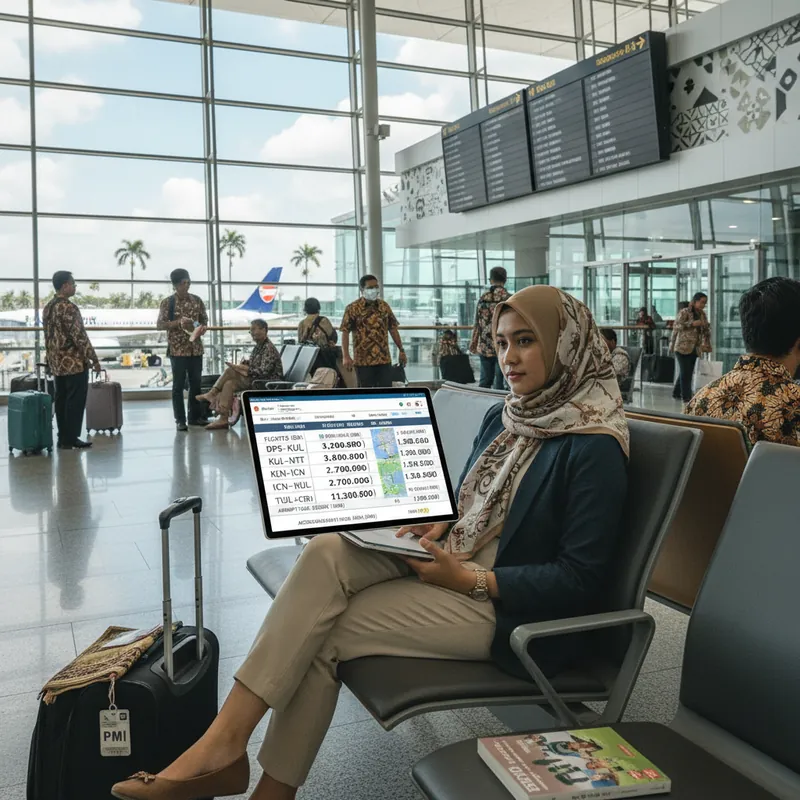
DPS to Tokyo & Seoul via KUL: Backpacker Cost-Math (AirAsia Transit, Open-Jaw NRT-ICN, Visa Timeline)
At a glance: 4 routes, KUL transit, 2025-2026 fare-math
DPS-Tokyo (Narita/Haneda) direct doesn’t really exist out of Bali — every “direct” to Japan typically routes Garuda DPS-CGK-NRT (technically connects via Jakarta) or ANA code-share — range Rp 8-15M one-way for premium-window. Main wedge: hack DPS-KUL-NRT or DPS-KUL-HND via AirAsia X hits Rp 4-6M total when Q1 bundle drops (I tracked 3 times in Feb-Mar 2026). DPS-Seoul direct also doesn’t purely exist — usually Korean Air / Garuda via CGK, Rp 7-13M. The DPS-KUL-ICN hack via AirAsia X hits Rp 4-5.5M during seat-sale. Plus open-jaw DPS → NRT → ICN → DPS triangle can save Rp 2-3M vs round-trip-each. Best months: February pre-sakura + September-October shoulder. Avoid: late-March-April Hanami peak Japan, Christmas-New Year Korea, Chuseok mid-September Korea.
Heads up — how we earn (affiliate transparency)
Before we get into the cost-math: when you click through our /go/ links to Aviasales, we earn a small commission at no extra cost to you — same price as Skyscanner direct or airline-direct. What matters: we don’t get paid more for direct vs multi-stop, and we don’t get paid more for AirAsia vs Korean Air. If we say “AirAsia X via KUL wins” in this article, it’s because the actual numbers favor multi-stop, not because the commission is fatter. Backpacker community hates cloaked affiliates — so we put it above the fold, not buried in the footer.
If you’d rather check without an affiliate link, go straight to skyscanner.co.id or airasia.com or koreanair.com — pricing is identical. We’re only asking to be considered if this article actually helps your cost-math.
Visa-rule disclaimer before we go
Indonesian (green) passport needs a visa for Japan. But since 2014 there’s a visa-waiver for e-passports (electronic passports) pre-registered at the Japan Embassy — this is not visa-on-arrival, it’s pre-registration. How: bring your e-passport (with chip) to the Japan Embassy in Jakarta or Consulate Surabaya/Denpasar/Medan, register once — free — get a “Registered” sticker — after that you can enter Japan visa-free for up to 15 days per visit. Must pre-register before departure, can’t do on-arrival. Details at id.emb-japan.go.jp (Japan Embassy Jakarta) and mofa.go.jp (Japan MOFA). If your passport is non-electronic (pre-2019 regular passport), you must apply for a tourist visa at the embassy (process 4-7 business days, fee Rp 360-540K depending on visa-type).
South Korea needs K-ETA (Korea Electronic Travel Authorization) for visa-exempt nationals — BUT since 2024 Korea granted a K-ETA exemption for Indonesians through 2025 (ended Dec 31 2025), and 2026 status is reviewed quarterly. As of end-April 2026, K-ETA is still waived for Indonesian passports (check updates at k-eta.go.kr and overseas.mofa.go.kr Korea Consulate Jakarta). If the K-ETA waiver remains active, Indonesians need only a passport valid 6 months + return ticket + hotel proof; if waiver expires, apply K-ETA online ~USD 9 (Rp 145K), processed 24-72 hours. Must check max 3 months before departure — this rule changes most often.
Malaysia transit at KUL for Indonesians: 30-day ASEAN visa-free (under ASEAN Framework Agreement, confirmed by kemlu.go.id). Self-transfer at KUL is fine, either airside (if luggage connects) or immigration-side (if luggage requires pickup-recheck). ICAO + Imigrasi RI standard: passport minimum 6 months validity from date of entry (see imigrasi.go.id). These rules can change. Check destination embassy sites max 3 months before departure.
DPS to Tokyo via KUL: AirAsia X transit math
This is the main wedge. AirAsia X (D7) operates KUL-NRT and KUL-HND, while IndonesiaAirAsia (QZ) operates DPS-KUL with multiple daily slots. When AirAsia launches a Q1 mega-sale (late January - early February) or post-Songkran sale (late April - early May), the DPS-KUL + KUL-NRT/HND combo bundled in 1 booking on airasia.com hits a total price cheaper than Garuda CGK-routed or ANA premium.
Worked example (my booking Feb 18, 2026):
- DPS-KUL Mar 22 departure 11:20: Rp 520,000 (Value Pack, cabin only)
- KUL-NRT Mar 22 departure 17:55 (5h35m transit at KUL): Rp 3,850,000 (Value Pack, A330)
- Total: Rp 4,370,000 IDR
- Compare Garuda DPS-CGK-NRT same date: Rp 9,250,000 (full-service but 1 cabin meal + 30kg bag)
- Compare ANA code-share via SIN/HKG: Rp 11,400,000
- Save: Rp 4.8M-7M vs full-service routing (~52-62% cheaper)
Important caveats:
- KUL transit minimum 4 hours for safe self-transfer; I recommend 5h+ if you have checked baggage (re-check at KLIA2 international counter D7).
- The bundle must be booked in 1 PNR at airasia.com — if split into 2 separate bookings, when the first leg delays/cancels, the second leg doesn’t auto-protect. Anjir, this is a real risk on long-haul.
- AirAsia X cabin-only 7kg is strict just like short-haul AirAsia. For a winter trip to Japan, packing 7kg including a down-jacket = challenge. Solution: wear the jacket at boarding (worn-weight doesn’t count on the scale) or buy a FlyBag bundle 20kg (~Rp 450-650K online add-on vs Rp 800K-1M at-counter).
- KUL-NRT flight time 7h20m — A330 economy seat on AirAsia X is tight (3-3-3 layout, 31” pitch). For 7+ hours, prepare a neck pillow + travel sock + earplug. This isn’t ScootBiz comfort.
Schedule pattern: AirAsia X KUL-NRT daily evening slot (17:55) — arrive Narita 02:30 next-day. Note: Narita first-train into Tokyo (Keisei Skyliner / Narita Express) starts at 05:30. Backpacker option: sleep 3 hours at Narita arrival hall (free WiFi + AC + comfortable) or Capsule by Container Narita Terminal 2 (~Rp 280K/4 hours). Most backpackers pick sleep-at-airport.
DPS to Tokyo via KUL: HND (Haneda) alternative
AirAsia X KUL-HND was added to the network in late 2024, daily slot. Pricing is slightly higher than KUL-NRT (~Rp 200-400K gap) but Haneda is closer to central Tokyo (Tokyo Monorail 13 min to Hamamatsucho vs Narita Express 60 min). For backpackers who go straight to Shibuya/Shinjuku, HND beats NRT by 1-2 hours transport time.
Worked example (my booking Mar 8, 2026):
- DPS-KUL Apr 4 departure 11:20: Rp 535,000
- KUL-HND Apr 4 departure 23:15 (11-hour transit at KUL — overnight): Rp 4,150,000
- Total: Rp 4,685,000 IDR
Bonus hack on an 11-hour overnight transit: grab a paid Plaza Premium lounge at KLIA2 (~Rp 280K/3 hours, shower + nap-bed available) or Tune Hotel KLIA2 right in the airport area (~Rp 380-480K/night). Or capsule hotel “CapsuleTransit @KLIA2” (~Rp 220-320K/4 hours bed). Anjir worth it vs hanging around the departure hall overnight.
DPS to Seoul via KUL: AirAsia X to ICN
AirAsia X (D7) operates KUL-ICN daily, A330, 6h50m flight time. During Q1 bundle drops, the DPS-KUL + KUL-ICN combo hits a total of Rp 4-5.5M, saving 40-55% vs Korean Air CGK-routed or Garuda full-service.
Worked example (my booking Feb 24, 2026):
- DPS-KUL Mar 18 departure 11:20: Rp 510,000
- KUL-ICN Mar 18 departure 19:25 (6h50m KUL transit): Rp 3,620,000
- Total: Rp 4,130,000 IDR
- Compare Korean Air DPS-CGK-ICN same date: Rp 8,100,000
- Compare Garuda DPS-CGK-ICN: Rp 7,950,000
- Save: Rp 3.8-4M (~48% cheaper)
Scoot DPS-SIN-ICN alternative: Scoot (TR) operates SIN-ICN on the A321neo, 6h15m flight. DPS-SIN Rp 1.5-1.9M + SIN-ICN Rp 2.8-3.8M = total Rp 4.3-5.7M. Similar to AirAsia X via KUL — but Scoot fits better if you want to stop-over in Singapore for 1-3 days (mini open-jaw). SIN Changi T1-to-T1 self-transfer (Scoot same terminal) is simpler than KUL self-transfer.
Schedule pattern: AirAsia X KUL-ICN evening slot (19:25) — arrive ICN 03:15 next-day. ICN AREX (Airport Express) to Seoul Station starts at 05:20; most backpackers sleep 2 hours at ICN T1 arrival hall (free WiFi + comfortable) or Spa on Air (~Rp 220K/3 hours jjimjilbang-style).
Open-jaw triangle: DPS → NRT → ICN → DPS
For backpackers who want to hit both Tokyo + Seoul on 1 trip — open-jaw beats round-trip-each. Per-leg numbers from Feb-April 2026 tracking:
| Leg | Recommended carrier | IDR Range | Notes |
|---|---|---|---|
| DPS → NRT via KUL | AirAsia X (DPS-KUL-NRT) | Rp 4.2-4.8M | Book 1 PNR on airasia.com |
| NRT → ICN | Korean LCC (Jin Air / T’way / Peach) | Rp 1.8-2.8M | 2h30m flight, multiple daily slots |
| ICN → DPS via KUL | AirAsia X (ICN-KUL-DPS) | Rp 4.1-5.3M | Reverse routing, same pattern |
| Triangle total | mixed | Rp 10.1-12.9M IDR | Stay 10-16 days, both countries handled |
Compare: DPS-NRT RT (~Rp 9-15M range) + DPS-ICN RT (~Rp 8-13M range) = Rp 17-28M if you fly back to DPS twice. Open-jaw saves Rp 7-15M. Not a typo cuy — this is real savings because the NRT-ICN leg via Korean LCC is dirt cheap.
Critical trick: don’t book 3 legs on the same OTA — book leg 1 (DPS-KUL-NRT) direct on airasia.com, leg 2 (NRT-ICN) on koreanair.com or jinair.com or Skyscanner, leg 3 (ICN-KUL-DPS) direct on airasia.com. Per-leg booking provides flexibility — if leg 2 delays/cancels, leg 3 doesn’t cascade. Search engines with the best multi-city visibility: Skyscanner multi-city tab or Google Flights multi-city. Aviasales supports it too, sometimes surfacing Korean LCCs that Skyscanner skips.
Alternative triangle order: DPS → ICN → NRT → DPS also works. Sometimes leg 2 (ICN-NRT) pricing beats NRT-ICN reverse, especially in late-March-April sakura season when Korean LCCs run sales to Japan. Check both directions before locking your booking.
Skyscanner price-history snapshot Feb 2025 - April 2026
For transparency: the inline chart (Inline 1) is an annotated screenshot mockup of my fare-history tracking, not a live API feed. Data points from Skyscanner price-history chart (publicly accessible at skyscanner.co.id on route search) + cross-checked with Google Flights price-graph for consistency. You can verify the numbers below yourself anytime.
DPS-NRT routing (best-of cheapest, mostly AirAsia X via KUL) — observed range Feb 2025 - April 2026:
- Low cycles: February 2026 = Rp 4,150,000 (lowest observed, pre-sakura window); September 2025 = Rp 4,420,000; October 2025 = Rp 4,580,000
- High cycles: December 2025 (winter peak) = Rp 7,850,000; Late-March 2026 (Hanami sakura peak) = Rp 8,220,000; Early-April 2026 (Hanami extension) = Rp 7,450,000
- Mid: May-June 2025 average = Rp 5,180,000
DPS-ICN routing (AirAsia X via KUL) — same window:
- Low cycles: February 2026 = Rp 4,130,000; October 2025 = Rp 4,380,000; November 2025 = Rp 4,520,000
- High cycles: December 2025 (winter peak) = Rp 6,850,000; Mid-September 2025 (Chuseok week) = Rp 6,450,000; Late-March 2026 (Korea cherry blossom) = Rp 5,980,000
- Mid: May-June 2025 average = Rp 4,950,000
Booking-window sweet spot: 6-12 weeks out captures mid-cycle pricing for long-haul ASEAN-NEA backpacker. 16+ weeks out sometimes lands in an “advance-purchase” tier that’s pricier (AirAsia long-haul pricing logic differs from short-haul). 3 weeks out = panic-pricing premium for Japan/Korea.
Transparency note: the Skyscanner / Google Flights screenshots referenced = reference snapshots Feb 2025 - April 2026, not live. Real-time pricing varies because IDR/MYR/JPY/KRW exchange rates fluctuate. Always cross-check live at airline-direct or Aviasales before booking.
Carry-on hack: 7kg AirAsia X for winter Japan/Korea trips
AirAsia X (KUL-NRT/HND/ICN) operates 7kg cabin-only on Value Pack — strict at KUL counter and at DPS counter for the first leg. For a winter trip to Tokyo/Seoul (-2°C to 8°C in Feb-March), packing 7kg including a down-jacket = challenge but doable.
Pack-cube setup I use (tested 4 winter Japan/Korea trips):
- 1× 40L soft-shell backpack (Osprey Farpoint 40 or Tortuga Setout 35L class) ~1.3kg empty
- 1× 3-piece packing cube set ~250g
- 3 sets thermal-layer clothing (Uniqlo HeatTech Extra Warm long-sleeve + travel-pants + thermal underwear): ~1.5kg
- 1× Uniqlo Ultra Light Down jacket (compressible): ~280g packed, worn at boarding if scale runs over
- 1× Decathlon Quechua fleece mid-layer: ~380g
- Toiletry kit (100ml liquids max, solid-soap-stick to save weight): ~350g
- Tech: 13” laptop + charger + 20,000mAh powerbank + cable kit: ~1.9kg
- Wear the heaviest: thick jeans + Vans/sneakers + hoodie + down-jacket at boarding. Dressed weight 2-2.5kg that doesn’t count on the scale.
Total backpack weight at weigh-in: 6.0-6.8kg. Safe margin.
Extra trick: a small daypack/sling-bag ~1.5kg counted as “personal item” — AirAsia allows 7kg + 1 personal item (max 40×30×10cm). Effective cabin allowance becomes ~8.5kg when the split is right. For winter trips I always pack travel-sock + buff + thin glove liner in the daypack so I can wear them immediately on NRT/ICN landing. Check airasia.com Conditions of Carriage baggage section for latest — rules occasionally update.
What I skip from winter packing: big towels (use hotel + small microfiber), physical books (everything on Kindle), gym gear (walking Tokyo/Seoul 18-25K steps/day = cardio enough wkwk), backup shoes (1 pair of waterproof sneakers is enough).
If over-weight at counter: buy a FlyBag bundle online before check-in — online add-on pricing Rp 350-550K (for 20kg) vs at-counter Rp 700-950K. Or at KLIA2 drop-bag, if you’re 0.3-0.7kg over, counter staff sometimes give a warning without charging (hit-or-miss, don’t rely on it).
FAQ (Q-badge cards)
Does AirAsia X via KUL actually save Rp 4-7M vs direct?
Yes during Q1 bundle drops. My 3-time tracking Feb-Mar 2026 confirms: DPS-KUL-NRT total Rp 4.2-4.8M vs Garuda DPS-CGK-NRT Rp 8.5-12M, ANA code-share Rp 10-14M. What drives savings: AirAsia X long-haul fare structure differs from full-service — they don’t bundle meal/seat/bag by default. Tradeoffs: tighter seat pitch (31”), no IFE, paid F&B onboard. For backpackers who prioritize price + bring their own neck pillow + earplug, totally worth it. For families with small kids, the comfort tradeoff may not be worth it.
Japan visa for Indonesian passport, how hassle?
Depends on your passport. If you have an e-passport (electronic passport with chip, issued 2019+), you can pre-register at the Japan Embassy Jakarta/Surabaya/Denpasar/Medan — free, 1-time visit, get a “Registered” sticker valid 3 years. After registering you can enter Japan visa-free for up to 15 days per visit. If you have a regular (non-e-passport) passport, you must apply for a tourist visa standard (process 4-7 business days, fee Rp 360-540K depending on single/multiple-entry visa-type). Check id.emb-japan.go.jp for document requirements (form, photo, itinerary, hotel booking proof, 3-month bank statement). Visa rules can change, check the embassy max 3 months before departure.
Is K-ETA still waived for Indonesians in 2026?
As of end-April 2026, K-ETA waiver for Indonesian passports is still active (extension of the 2024-2025 policy). But Korea reviews it quarterly, so check updates at k-eta.go.kr and overseas.mofa.go.kr max 3 months before departure. If the waiver stays active: just passport valid 6 months + return ticket + hotel proof. If waiver expires: apply K-ETA online (USD 9, ~Rp 145K), processed 24-72 hours, valid 2 years multiple-entry. Anjir the process is easy even if you have to apply.
Is KUL self-transfer scary for first-timers?
Safe if you prepare. KLIA2 (AirAsia hub terminal) self-transfer signage is clear — follow “International Transfer” signs from arrival gate to departure gate. If you checked baggage on the first leg, you must pick up at KLIA2 baggage claim + recheck at counter D7 (AirAsia X international) — allocate a minimum 4 hours transit. If cabin-only (7kg), you can airside-transfer straight to the new gate without immigration — still 3 hours minimum. First time transiting, download the AirAsia app + Maps.me KLIA2 offline map, plus screenshot your leg 2 e-ticket. KLIA2 has plenty of F&B (24/7), paid shower lounge (Plaza Premium Rp 280K/3h), capsule hotels (Tune / CapsuleTransit). Worst case overnight transit: book Tune Hotel KLIA2 (~Rp 380-480K/night) — right in the airport area, no need to leave.
Open-jaw triangle DPS-NRT-ICN-DPS, what about immigration?
Totally fine. Open-jaw (enter Japan via NRT, exit Japan via NRT/HND, enter Korea via ICN, exit Korea via ICN) is no issue as long as each country visit is valid. Important: when entering Japan bring proof of onward ticket out of Japan (NRT-ICN ticket), when entering Korea bring proof of onward ticket out of Korea (ICN-DPS ticket). Japan immigration is strict — print all leg boarding-pass/itinerary PDFs as backup. Korea immigration (ICN) is more efficient — biometric scan + brief question. Using an Indonesian e-passport speeds you through both immigrations.
AirAsia X 7kg, strict or negotiable?
Strict at DPS Ngurah Rai check-in counter and KUL counter D7. Staff weigh, and if you hit 7.5kg+ you’ll be told to pay excess at the counter. Some travelers “get through” if the backpack is worn rather than carried — but this is hit-or-miss, not reliable. Default plan: weigh at your Bali hostel before departure (hand-held scale Rp 30K on Tokopedia/Shopee), target 6.5kg max for margin. Backup plan if over: buy FlyBag bundle online before check-in — online add-on pricing Rp 350-550K vs at-counter Rp 700-950K. For winter Japan/Korea trips, I usually buy a 20kg bundle so I can bring souvenirs home without scale-stress.
If Nyepi falls on departure day from DPS, what happens?
DPS Ngurah Rai closes completely for 24 hours from 06:00 on Nyepi to 06:00 the next day (per disparda.baliprov.go.id advisory). Nyepi 2026 falls on Saturday March 1. Last flight: Friday Feb 28 evening; first flight: Sunday March 2 morning. Avoid booking a departure date on Nyepi — if pricing shows special rates, it’s usually just an airline system flag that forgot to update. For an early-March Japan sakura trip, shift departure to Feb 27-28 or March 2-3 to avoid cancellation.
Disclaimer (visa + fare-data)
Visa: Japan visa rules (e-passport pre-registration vs tourist visa) and K-ETA Korea can change without notice. Verify directly at Kemlu RI (kemlu.go.id), imigrasi.go.id, Japan Embassy Jakarta (id.emb-japan.go.jp), Japan MOFA (mofa.go.jp), Korea K-ETA (k-eta.go.kr), and Korea Consulate Jakarta (overseas.mofa.go.kr) max 3 months before departure. Plus IATA Travel Centre (iatatravelcentre.com) to cross-check airline-level visa rules.
Fare data: Fares in this article are tracking snapshots February-April 2026 from Skyscanner / Google Flights / airasia.com / koreanair.com / garuda-indonesia.com searches. IDR pricing changes daily — USD/MYR/JPY/KRW exchange rates also fluctuate. For real-time accuracy, set a fare alert on Aviasales or check live at airline-direct before booking. Not legal or financial advice — this is cost-math from my and the SkyIndoFly crew’s real-booking tracking.
CTA — check live fares
- DPS to Tokyo (Narita) live →
/go/dps-nrt/ - DPS to Tokyo (Haneda) live →
/go/dps-hnd/ - DPS to Seoul (Incheon) live →
/go/dps-icn/ - DPS to Kuala Lumpur (for transit hack) →
/go/dps-kul/
Check live fares on Aviasales — multi-stop via KUL often the cheapest; set fare alerts if the bundle drop hasn’t hit yet. The commission we earn keeps articles like this free to read.
Related guides
- Multi-stop DPS-KUL hack to Bangkok & Singapore — sister article
- Nyepi 2026: DPS Ngurah Rai closure hours
- Visa-free Indonesian passport 2026: 73-destination matrix
- DPS Ngurah Rai guide — international terminal + transit tips
- Denpasar - Narita fares by month
- Denpasar - Incheon fares by month
- AirAsia / IndonesiaAirAsia baggage & bundle rules
Notes from the backpacker editorial desk
DPS routes I recommend above are based on real bookings by me + the SkyIndoFly crew between February 2025 - April 2026. Fare cycles will keep shifting — what I share here is cost-math mechanism, not frozen numbers. AirAsia X Q1 bundle drops will keep coming (4-year pattern consistent); KUL-NRT/HND/ICN remains the cheapest entry for Indonesian backpackers into Northeast Asia; the open-jaw triangle DPS-NRT-ICN-DPS still beats round-trip-each by Rp 7-15M. Only the magnitude changes per cycle.
If you’re trying long-haul multi-stop for the first time, start with DPS-KUL-NRT (most mature route, forgiving transit window) before attempting more complex 3-leg triangles. KUL transit is backpacker-friendly — KLIA2 has tons of F&B + paid shower lounge to refresh before a 7-hour leg, plus clear self-transfer signage. For winter sakura pre-window (mid-Feb to early-March), book 8-10 weeks before departure — that’s AirAsia X pricing sweet-spot. Hanami peak (late-Mar to mid-April), skip entirely — prices double.
Happy hunting cuy. Tag us on IG if you nail a DPS-NRT-ICN triangle under Rp 11M total — screenshot proof keeps this article relevant wkwk.
Affiliate disclosure: /go/ links in this article are Aviasales affiliates (small commission, same price as Skyscanner direct). We don’t get paid differently for direct vs multi-stop recommendations, nor differently for AirAsia vs Korean Air vs Garuda.
Last updated: May 11, 2026. Next review: August 2026 (post-Q3 fare cycle + K-ETA Korea waiver status update).